
Do You Need a New Barcode for Each Variant? The GTIN Rules
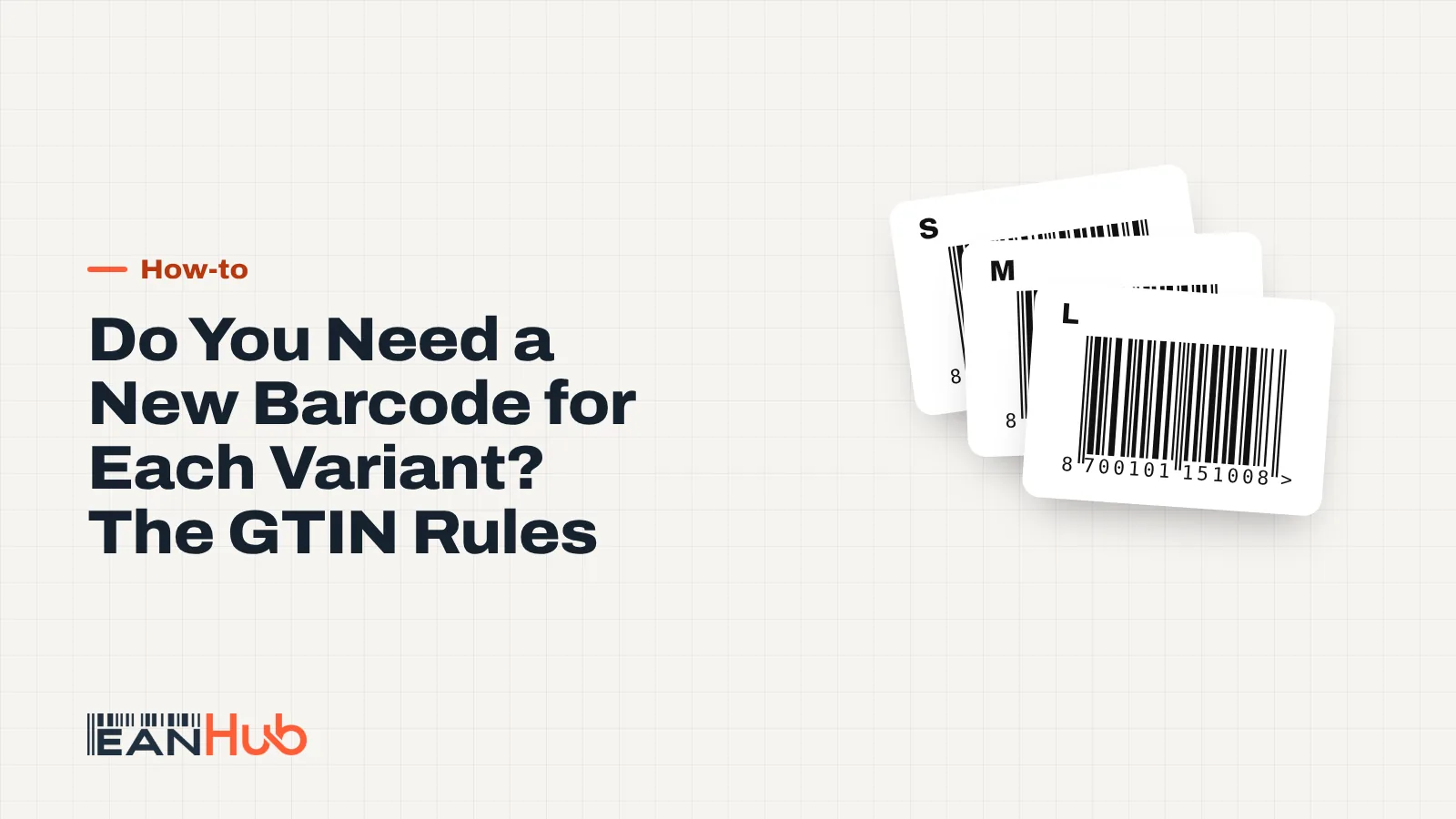
Yes: every size, colour or other variant a customer can choose needs its own barcode. You also need a new one for multipacks, fixed bundles and certain product changes, such as a different net content or a dimension change of more than 20 per cent.
Key points
- One barcode per variant: every size, colour and size-colour combination gets its own EAN.
- Multipacks and fixed bundles are new products with their own EAN.
- Changing net content, the primary brand or a pre-printed price needs a new EAN.
- A physical change of more than 20 per cent on any axis, or in gross weight, needs a new EAN.
- Since 2019, a GTIN must never be reused for a different product.
You're about to launch a hoodie in four sizes and three colours, and a customer has asked whether you'll do a two-pack. Before you print a single label, you need to know how many barcodes this range actually needs. Here's the short answer: you need a new barcode for each variant a customer can choose, so 4 sizes × 3 colours means 12 EANs, and the two-pack is a separate product with its own number.
The rules behind that come from the GS1 GTIN Management Standard. Below you'll find them in plain English, with counting examples you can copy for your own range.
The core rule: a new barcode for each variant
GS1 UK puts it simply: if your product comes in different colours or sizes, or is sold as a multipack, you need a GTIN for each variety. GS1's global support pages give the classic example. A one-size T-shirt sold in three colours needs three separate GTINs, because with one shared number nobody in the supply chain can tell which colour to send.
The test is practical. Ask yourself: if a customer ordered this by barcode alone, would the warehouse know exactly what to pick? If two items could be confused, they need different numbers.
Hoodie 'Harbour'
| Navy | Grey | Forest | |
|---|---|---|---|
| S | …00013 | …00020 | …00037 |
| M | …00044 | …00051 | …00068 |
| L | …00075 | …00082 | …00099 |
| XL | …00105 | …00112 | …00129 |
12 variants = 12 EAN codes
Google Merchant Center follows the same logic: its GTIN help page asks for a separate GTIN for each colour or size variant.
When do you need a new EAN? The GS1 change rules
Variants are the easy part. The trickier question is what happens when an existing product changes. The GS1 UK GTIN management handbook lists the situations that require a new number. These are the ones that matter most to small and mid-sized UK sellers:
| Change | New EAN needed? | Example |
|---|---|---|
| New product added to your range | Yes | You launch a lavender candle next to your vanilla one |
| New size or colour variant | Yes | The hoodie gets a fourth colour |
| Declared net content changes | Yes, at all levels | A nappy pack goes from 12 to 10 |
| Dimension on any axis or gross weight changes by more than 20% | Yes | Switching from a plastic to a glass jar raises gross weight by 50% |
| Primary brand on the pack changes | Yes | You rebrand from "Harbour" to "Quayside" |
| Certification mark added or removed (if it matters to buyers or regulators) | Yes | An organic logo appears on the label |
| Pre-printed price on pack changes | Yes | A price-marked pack goes from £2 to £2.50 |
| Price applied with a removable sticker | No | Shop price labels |
| Minor recipe tweak that doesn't change legal declarations | No | A supplier swap with identical labelling |
| Pre-defined bundle contents change | Yes | Your gift set swaps a mug for a tumbler |
| Random assortment changes (e.g. mixed colours) | No | A box of assorted-colour toothbrushes |
Two of these deserve a closer look.
The 20 per cent rule
GS1's rule reads: a change to a physical dimension, on any axis, or to gross weight of more than 20 per cent requires a new GTIN. GS1 measures this cumulatively since the GTIN was last assigned, and it explicitly calls it unacceptable to make a series of small changes to stay under the limit. A box that grows 40 per cent in height, from 7.6 cm to 10.64 cm, is GS1's own example.
Why does it matter? Warehouses, shelves and couriers plan around the dimensions recorded against a number. If your box quietly gets much bigger under the same EAN, pallets no longer fit and shipping charges are wrong.
Price-marked packs
This one is very British. The GS1 UK handbook says a change to a pre-printed price on the pack, for example from £2 to £2.50, needs a new GTIN at all levels. A price added with a removable sticker does not.
Multipacks and bundles
A multipack or bundle is something a customer buys as one unit, so it is a new trade item. Treat it like a new product:
- Multipack of identical items (for example a 3-pack of the same socks): one new EAN for the pack. The single socks keep their own numbers.
- Fixed bundle of different items (a gift set with a candle, a diffuser and matches): one new EAN for the set.
- Random assortment (a box of mixed colours where the customer doesn't choose): one EAN for the assortment, and GS1 says it doesn't need a new one when the mix changes.
For shopping feeds, Google adds a twist. If you created the multipack or bundle yourself, Google wants the GTIN of the individual product (for multipacks) or the main product (for bundles) in your feed, together with the multipack or bundle attribute. That is a feed rule, not a numbering rule: you still need a separate EAN on the pack for your own stock control and for marketplaces that list the bundle as its own product.
Can customers choose it as a separate option?
YesNew EAN per variant
Did net content, brand or printed price change?
YesNew EAN
Did a dimension or weight change by over 20%?
YesNew EAN
Is it a fixed set whose contents changed?
YesNew EAN
Keep the existing EAN
Never reuse a barcode
It's tempting to recycle the number of a product you stopped selling. Don't. The GS1 non-reuse rule took effect on 1 January 2019: a GTIN that has been allocated to a product shall not be reallocated to another product. Numbers discontinued before the end of 2018 could be reassigned once after a 48-month wait, and never again after that.
The practical reasons are as strong as the rule itself. Old listings, reviews and stock records stay attached to the number. Reuse it for a different product and your new item inherits the old product's photos and reviews on marketplaces, or clashes with leftover stock somewhere in the supply chain. If you relaunch the identical product, though, you can use its original number again.
Worked counting examples
Example 1: a small clothing brand
You sell one T-shirt design in 5 sizes (XS–XL) and 2 colours, plus a 3-pack in black only, in sizes S, M and L.
- Single T-shirts: 5 × 2 = 10 EANs
- 3-packs: 3 sizes × 1 colour = 3 EANs
- Total: 13 EANs
If you add a third colour next season, that's another 5 for the singles, plus 3 more if the 3-pack comes in that colour too.
Example 2: a dog treat maker
You bake dog treats in 3 flavours, each in a 150 g and a 400 g pouch, and sell a fixed tasting box with one 150 g pouch of each flavour.
- Singles: 3 × 2 = 6 EANs
- Tasting box: 1 EAN
- Total: 7 EANs
Next year you move the 400 g size from a pouch into a resealable tin, and its gross weight rises from 420 g to 560 g. That's a 33.3 per cent increase, over the 20 per cent threshold, so all three 400 g flavours need new EANs: 3 more. The net content is still 400 g, so it is the weight rule that triggers the change. The tasting box only contains 150 g pouches, which haven't changed, so it keeps its EAN.
Example 3: a food seller with price-marked packs
You sell a sauce in one 250 ml bottle. For a retail promotion, you print "£2.99" on the label. That price-marked version needs its own EAN. When the printed price moves to £3.29, it needs another.
When a GS1 membership is the better choice
The counting rules are the same wherever your numbers come from. What differs is where you can sell with them. If you're launching branded products on Amazon, supplying a supermarket or high-street chain, or working with any partner that checks Verified by GS1, license your numbers from GS1 UK. Those channels expect to see your company in the GS1 registry, and our codes will not show you there.
For unbranded goods, handmade products, small webshops and marketplaces that don't run a GS1 check, buying a set of codes once is often the more practical route. Either way, give every variant its own number from day one.
What to do now
- List every variant a customer can choose, plus every multipack and fixed bundle.
- Multiply sizes by colours (and any other option) to get your variant count.
- Before changing a product, check the change table above: net content, brand, printed price and the 20 per cent rule are the usual triggers.
- Never recycle an old number for a different product.
- Validate every number with the EAN checker before it goes into your shop, and see the EANHub blog for the next steps.
Frequently asked questions
Can I use the same barcode for different colours?
No. GS1 says each colour, size or combination of the two needs its own GTIN. If three colours share one number, a warehouse or marketplace can't tell which colour to pick, and returns and stock counts go wrong. Google Merchant Center also asks for a separate GTIN per colour or size variant.
Do I need a new barcode if I change the packaging design?
Not for a purely visual redesign. A new GTIN is needed when the change hits one of the GS1 triggers: different declared net content, a change to the primary brand, a physical dimension or gross weight change over 20 per cent, a change in certification marks shown on pack, or a different pre-printed price.
Can I reuse a barcode from a product I've discontinued?
No. Under the GS1 non-reuse rule, which took effect on 1 January 2019, a GTIN allocated to a product must never be reallocated to another product. If you bring the identical product back, you can use its original number again, but a new or changed product needs a fresh one.
Does a gift set made of my own products need its own EAN?
Yes, if you sell it as a fixed set with set contents. A pre-defined bundle is a separate trade item. Under the GS1 rules, if the contents of that set later change, the set needs a new GTIN as well. Our guide on how to look up a barcode helps you check numbers before you assign them.
Do Amazon FBA labels replace the need for an EAN per variant?
No. Amazon's FNSKU label identifies your stock inside Amazon's warehouses. The product ID you list with is a separate thing, and each variant normally needs its own one. Check Seller Central for the exemption rules that apply to your category as of October 2026.
Sources
More articles
All articles-
 How-to EAN Code Lookup: How to Find Who Owns a Barcode An EAN code lookup starts with three checks: is the number valid, which company licensed it, and where is it already listed for sale. Verified by GS1, marketplace search and a check digit tool each answer one of those questions, and none of them answers all three. 10 min read
-
 How-to How to Add GTIN to Shopify, WooCommerce and BigCommerce To add a GTIN to Shopify, put the 13-digit EAN in the Barcode field of each variant, not just the product. WooCommerce and BigCommerce work the same way: one EAN per variant in the platform's identifier field, then let your feed send it to Google and marketplaces. 9 min read
-
 How-to Missing GTIN in Google Merchant Center? How to Fix It A missing GTIN warning in Google Merchant Center means Google expects a barcode number for that product and didn't receive a valid one. Fix it by sending the correct 13-digit GTIN with the brand, or, only for products that genuinely have no identifiers, by setting identifier_exists to no. 9 min read
-
 How-to How to Print Barcode Labels Yourself (That Actually Scan) To print barcode labels yourself, generate the barcode as a vector file, size it between 80 and 200 per cent of the nominal EAN-13 size, and print it on a thermal or laser printer with the module width matched to the printer's dots. Then test-scan a sample before you print the full run. 9 min read